

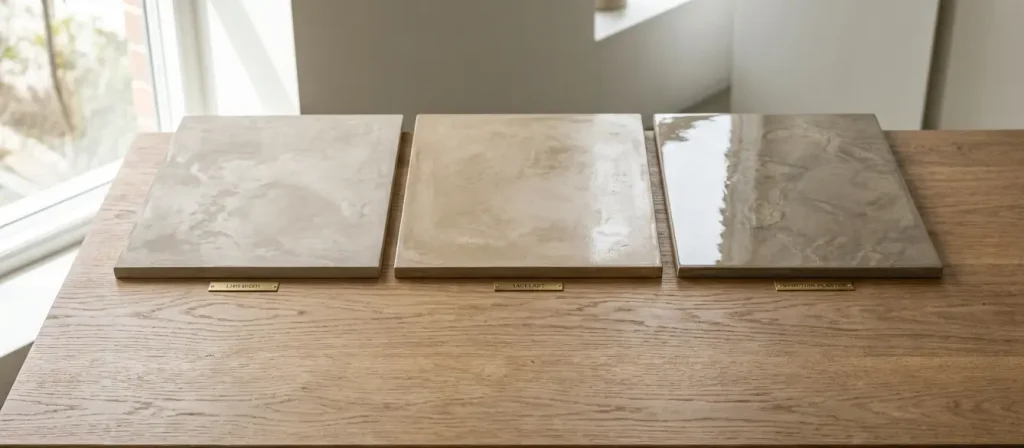
Lime based wall finishes offer distinct textures and mineral character for interior and exterior spaces. While traditional Limewash, Tadelakt, and Venetian Plaster are lime based finishes, their formulations, application methods, and moisture handling properties vary significantly.
At a Glance: Key Differences
| Feature | Limewash Paint | Tadelakt Plaster | Venetian Plaster |
| Visual Finish | Soft, matte, subtle mottled shading | Smooth, low gloss, organic sheen | Smooth, polished gloss |
| Water Resistance | Low (absorbs liquid moisture) | High water resistance (when soap treated) not waterproof | Moderate to high (with protective sealer) |
| Shower Use | Unsuitable | Not universally recommended; system dependent | Unsuitable for direct water contact |
| Application Method | Masonry brush (crosshatch) | Trowel & stone burnishing | Multi layer steel trowel |
| DIY Feasibility | Moderate | Very Low (Requires specialist trades) | Low (Requires skilled trades) |
| Best For | Bedrooms, living spaces, masonry | Feature walls, low impact wet zones | Accent walls, dining areas |
Material Formulations and Visual Character
Limewash: Mineral Bonding and Carbonation
Limewash is a thin slurry made from slaked lime (Ca(OH)₂), water, and mineral pigments. It forms a breathable mineral layer that bonds with porous substrates, curing through carbonation as calcium hydroxide reacts with atmospheric carbon dioxide [2]:
Ca(OH)₂ + CO₂ → CaCO₃ + H₂O
Applied with a wide masonry brush in overlapping crosshatch motions, it dries to a soft, non reflective finish with subtle cloud like mottling.
Tadelakt: Stone Burnished Moroccan Plaster
Originating in Morocco, Tadelakt is a lime plaster technique where wet material is compacted using a polished river stone. During application, an olive oil soap solution (rich in oleic acid) is worked into the curing lime. The fatty acids react with calcium to form hydrophobic, water insoluble calcium soaps (lime soaps), creating a low absorption, water resistant surface without grout lines.
Venetian Plaster: Layered Marble Dust and Lime
Traditional Venetian plaster formulations combine slaked lime putty [3] with finely ground marble dust. Artisans apply multiple paper thin coats using a specialized steel trowel, compacting and burnishing each layer to create a reflective surface with visual depth similar to polished stone.
Moisture Performance in Bathrooms and Wet Areas
How a finish interacts with liquid water dictates where it is appropriate to specify [1]:
- Tadelakt in Showers: What to Consider: While some manufacturers market Tadelakt for shower interiors, industry guidelines vary considerably. European manufacturers such as Kreidezeit explicitly advise against using Tadelakt in shower enclosures, bathtub surrounds, or sinks, emphasizing that the material is water resistant rather than fully waterproof. Where specified in wet zones, Tadelakt should be installed over a suitable rigid substrate and a code compliant waterproofing system appropriate for the assembly, and periodically re-soaped with olive oil soap when water repellency declines.
- Limewash Permeability: Limewash is highly vapor permeable, allowing moisture vapor to pass through porous wall assemblies without trapping water behind a synthetic film [1]. However, unsealed limewash readily absorbs liquid water and is not intended for direct splash zones.
- Venetian Plaster: Performs well in high humidity rooms when protected with a product specific wax or sealer. However, standing water inside a shower enclosure can dull its sheen and degrade the lime matrix over time.
Application Realities: DIY vs. Professional Skill
- Limewash (DIY Accessible): Forgiving for homeowners comfortable with paint application. Minor variations in brushwork integrate naturally into the mottled aesthetic.
- Tadelakt & Venetian Plaster (Professional Trade Required): Tadelakt requires precise timing and controlled pressure during stone burnishing to achieve proper density without micro cracking. Venetian Plaster relies on refined trowel control to build even layers without edge marks.
Which Lime Finish Is Best for Your Space?
- Choose Limewash if you want a soft matte finish on living room or bedroom walls, prefer a forgiving DIY application, or need a breathable coating for porous masonry.
- Choose Tadelakt if you are designing a feature wall, low impact wet zone, or integrated architectural feature where a joint free, water resistant surface is desired and you can commit to periodic soap maintenance.
- Choose Venetian Plaster if you want a smooth, light reflecting accent wall with the visual depth of natural stone in non shower interior spaces.
Technical References
- Building Science Corporation — Lstiburek, J. (2006): Understanding Vapor Barriers (BSD-106). Technical guidance on moisture transport, vapor movement, and wall assembly permeability principles.
- Ashurst, J. and Ashurst, N. (1988): Practical Building Conservation: English Heritage Technical Handbook, Vol. 3 — Mortars, Plasters and Renders. Gower Technical Press. Technical reference covering lime production, slaking, carbonation, mortars, plasters, and traditional finishing materials.
- ASTM International — ASTM C1489: Standard Specification for Lime Putty for Structural Purposes. Material specifications and terminology for lime putty used in traditional lime based construction materials.



1 thought on “Limewash vs Tadelakt vs. Venetian Plaster: Finding the Right Lime Finish for Your Space”
Comments are closed.