
Unique small coffee tables let a compact apartment, studio, or bungalow feel designed instead of default. When floor space is tight, a standard rectangular table can crowd the room, while a smaller piece with an interesting shape or material becomes the focal point without taking over. This guide covers eight distinctive styles, how to size them, what each material is like to live with, and how to test a table in your own room before you buy.

The short version
- Aim for a table about ½ to ⅔ the length of your sofa, with a top level with your seat cushions or an inch or two below. In a very small room, walking space matters more than hitting those ratios.
- Choose a material you will actually maintain. Marble can both stain and etch, and sealer only helps with staining. Acrylic scratches easily and is sensitive to the wrong cleaner.
- For storage tables, measure the clearance you need to open them before you commit.
Why Choose a Unique Small Coffee Table?
- A focal point without bulk. A sculptural base, a distinctive texture, or a rounded top draws the eye without eating floor space.
- Easier movement. Curved and oval shapes remove sharp corners from walkways. That is a practical benefit, though it doesn’t add actual square footage.
- Flexibility. Smaller tables are easier to move when you need open floor for a workout, a work-from-home setup, or guests.
- The trade-off. Smaller and more unusual tables usually offer less surface area. Decide up front what you’ll put on it: drinks and a remote need little room, while a laptop or a meal needs more.
Two more questions before you shop. Where is the tightest walkway in the room? That path, more than the sofa, often decides the table size. And who uses the space? Kids, pets, and frequent guests change what makes sense in edge shape, glass safety, and finish.
8 Unique Small Coffee Table Styles
Here is the quick comparison. Details on each style follow the table.
| Style | Good for | Main trade-off |
|---|---|---|
| Pedestal or curved | Open floor, softer corners | Less surface area |
| Burl, live-edge, stone | Texture in neutral rooms | Weight, moisture, acid |
| Nesting or C-table | Flexible surfaces | Larger footprint when expanded |
| Glass or acrylic | A lighter look | Fingerprints, scratches |
| Fluted or tambour storage | Storage without swing-out drawers | Dust in grooves, track quality |
| Lacquer or postmodern | A statement color | Shows scratches and smudges |
| Vintage trunk or drum | Deep storage, character | Lid access, condition |
| Ottoman plus tray | Seat, footrest, and table | Needs a rigid tray |
1. Sculptural pedestal and asymmetrical tables

What it looks like: a single central base with a round, oval, or kidney-shaped top, so there are no legs at the corners.
Works best: in front of a straight-lined sofa, where a curve softens the geometry, and in rooms where you want to see more floor.
Check before buying: the usable surface area, since curved tops give you less than a rectangle of the same footprint. Also check stability when you set heavy items near the edge, and whether the base is wide enough to clear your feet when you sit.
2. Burl wood, live-edge, and natural stone

What it looks like: swirling burl grain, a raw natural edge, or a solid stone slab. Each piece is slightly different.
Works best: in neutral, minimalist rooms that need texture and a grounded feel.
Check before buying: stone’s weight and acid sensitivity (covered below), veneer’s vulnerability to moisture, and whether the piece sits level on your floor. Heavy slabs and uneven floors can rock.
3. Nesting tables and C-tables
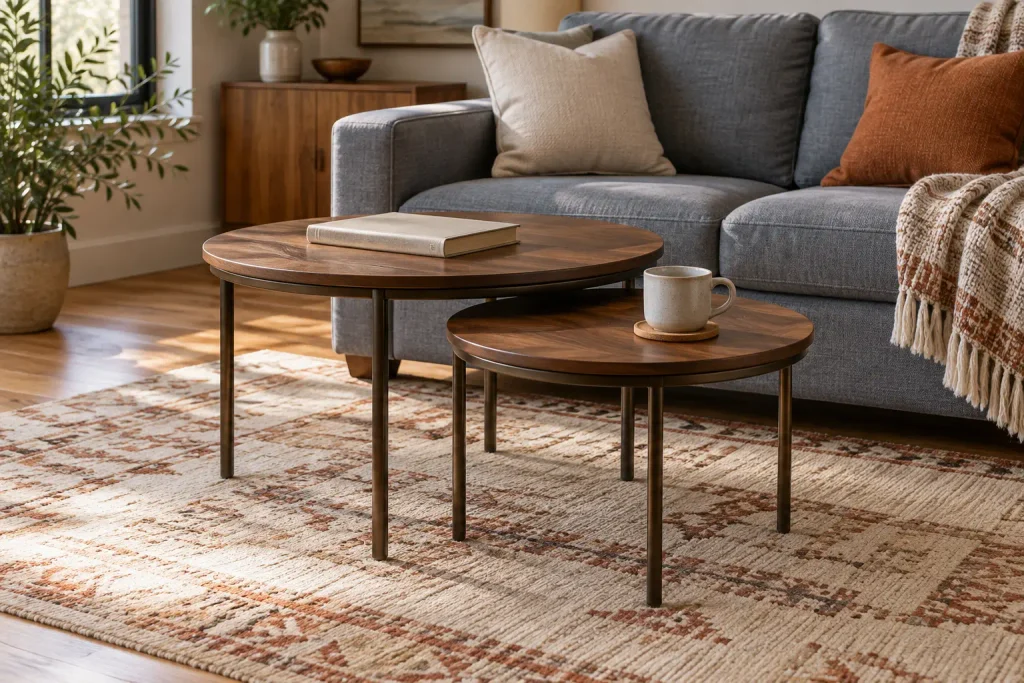
What it looks like: two or three stacked tables of graduated size, or a C-shaped table with a base that slides under the sofa.
Works best: in multi-use living rooms, where you need a small surface most days and extra surfaces for guests, or as a side-of-sofa surface for a laptop.
Check before buying: how much floor a nesting set needs when spread out, and, for C-tables, your sofa’s under-clearance against the thickness of the base.
4. Transparent glass and acrylic

What it looks like: a clear top on slim legs or a solid acrylic form.
Works best: in dark or very small rooms and over patterned rugs you want to keep visible.
Check before buying: for glass, tempered glass with polished or rounded edges. For acrylic, how you plan to clean it (see the care section). Both show dust and fingerprints.
5. Fluted wood and tambour storage tables
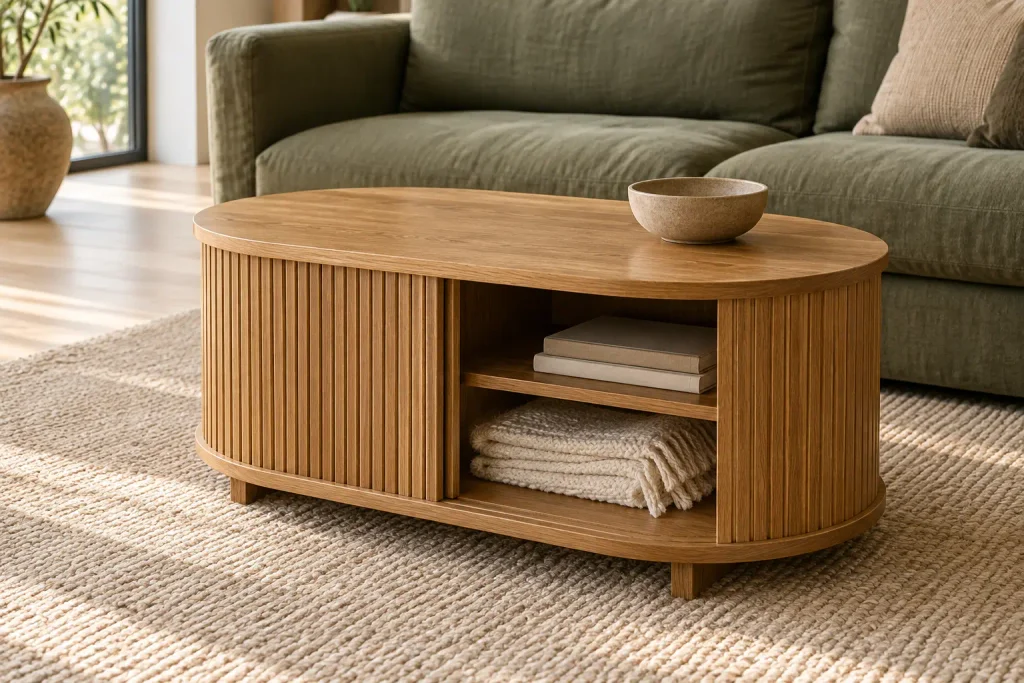
What it looks like: vertical slats on the sides, sometimes with flexible slatted doors that slide open along the perimeter.
Works best: when you want storage without drawers or doors swinging into the walkway.
Check before buying: ask what you actually want. If you only want the ribbed look, a solid fluted table is simpler. If you want working storage, think about what you will keep inside and confirm the doors open fully without hitting the sofa, and that the track moves smoothly. Dust collects in narrow grooves, so expect regular wiping.
6. Lacquer, pop art, and postmodern pieces
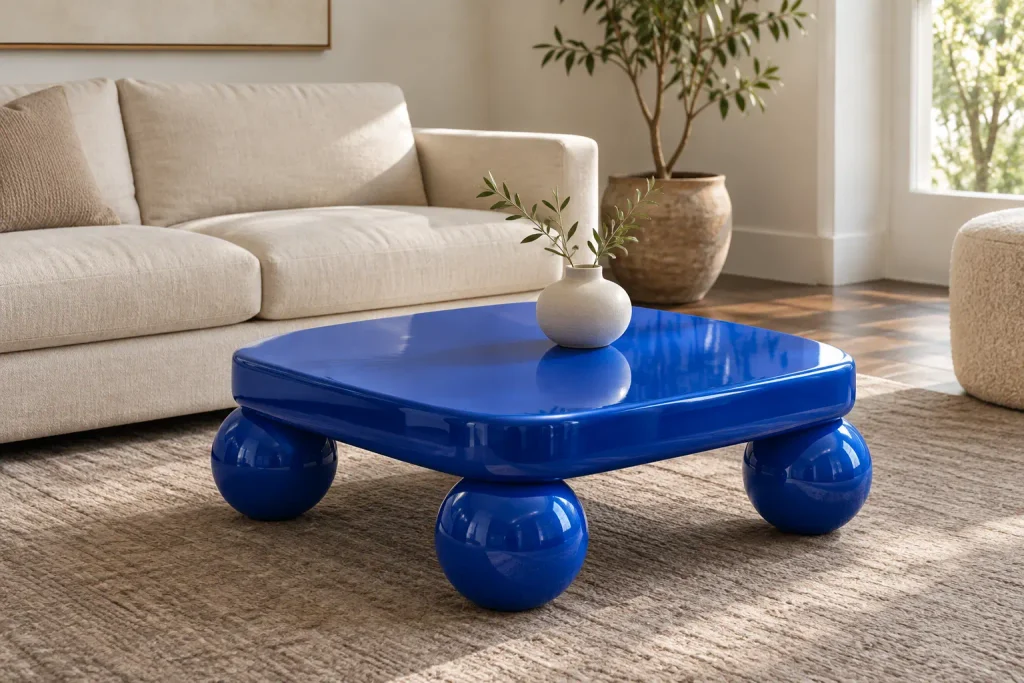
What it looks like: high-gloss finishes in saturated colors such as cobalt, forest green, or terracotta, often with playful geometry.
Works best: in a mostly neutral room where one bold piece is the accent.
Check before buying: gloss finishes show smudges and hairline scratches under direct light, and chips on painted edges are hard to hide.
7. Upcycled vintage trunks and drums
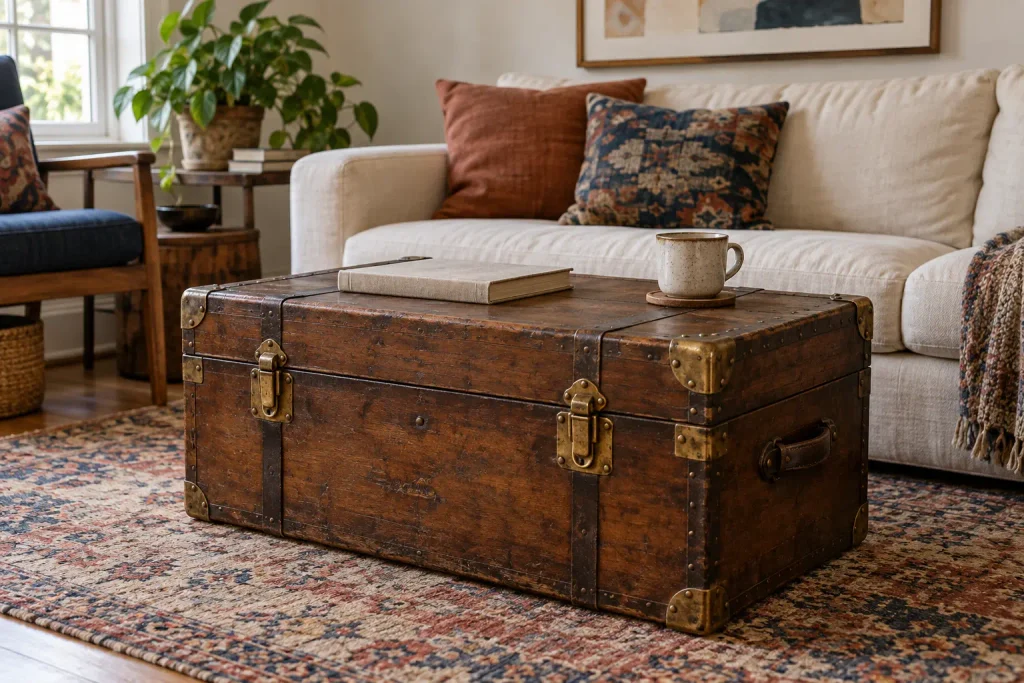
What it looks like: an old steamer trunk, a brass drum, or a repurposed industrial piece with a flat top added.
Works best: in eclectic rooms where you want character and deep storage in one piece.
Check before buying: how the lid opens, because everything on top has to move first. Also check the condition of the finish and interior, and how much weight the lid is designed to hold.
8. Ottoman and pouf hybrids

What it looks like: an upholstered ottoman paired with a flat tray, working as a footrest, spare seat, and table.
Works best: in homes with kids or frequent guests, where soft corners and flexible seating matter.
Check before buying: the tray. It should be rigid and non-slip so drinks stay put. Also consider how easily the fabric cleans and how firm the top is.
How to Size It
These numbers are long-standing design conventions, not building codes. Most published guides come from furniture retailers, so treat them as a starting range and test in your own room.
Height. Standard sofa seats run about 17 to 19 inches off the floor. A common guideline puts the table level with the seat or 1 to 2 inches below it, which usually means 16 to 18 inches. Measure your own sofa first, since a low-profile sofa calls for a lower table. If you often work or eat at the table, a slightly taller table or a lift-top may serve you better, at the cost of looking out of proportion with the sofa.
Length. The usual rule is one-half to two-thirds of the sofa’s length (Sizemarker). My arithmetic for common sofa sizes:
| Sofa length | Table length (½ to ⅔) |
|---|---|
| 72 in | 36–48 in |
| 78 in | 39–52 in |
| 84 in | 42–56 in |
In a studio or very tight room, a round table about 24 to 30 inches across is a common choice. There, walking space takes priority over the length rule.
Distance from the sofa. The common range is 14 to 18 inches between the sofa front and the table edge. Very tight rooms sometimes go as low as 12 to 14 inches, but legroom suffers below that.
Walkway clearance. Guides disagree here. One suggests 30 to 36 inches between the table and a TV stand, while another says 24 to 30 inches is workable in tighter rooms. A practical read: aim for 30 to 36 inches where you can, and treat about 24 inches as a tight minimum. For reference, ADA accessibility guidance generally calls for a minimum continuous clear width of 36 inches, with additional clearance needed for certain turns. Use this as a planning reference, not a universal rule for residential furniture layouts.
Materials and Care
Marble, travertine, and other calcium-based stone
Marble can both stain and etch, and the two are different problems. Staining is liquid absorbed into the pores. Etching is the dull, lighter spot left when something acidic, such as lemon juice, wine, vinegar, or soda, reacts with the stone’s surface.
A penetrating sealer helps improve stain resistance, but it does not prevent acid etching. Stone-care sellers consistently make this point, for example Dynamic Stone Tools and STAIN-PROOF. The reason is that acid reacts directly with the calcium carbonate at the surface, regardless of what is happening inside the stone. The same applies to limestone, travertine, and onyx.
- Practical defense: use coasters and a tray, wipe spills right away, and avoid acidic cleaners, including vinegar-based ones.
- Etched spots usually need polishing or professional refinishing.
- Weight matters. By my rough estimate, a marble top about 36 × 20 inches and 1¼ inches thick weighs somewhere around 80 to 90 pounds. That’s a real consideration for stairs, renters, and anyone who rearranges often.
- Several of these sources sell stone-care products. They agree with each other on this point, but keep their commercial interest in mind.
Acrylic and Lucite
- For routine cleaning, use mild soap, lukewarm water, and a soft damp cloth. Dry-wiping a dusty surface can scratch it.
- Avoid ammonia-based glass cleaners. Ammonia can attack acrylic and cause crazing, a network of fine cracks that clouds the surface (WeTop Acrylic). Some newer glass cleaners are ammonia-free, so a brand name alone doesn’t settle it, and one care guide suggests skipping glass cleaner entirely.
- For disinfection, follow the furniture manufacturer’s approved products and instructions, since solvents and alcohol can damage the surface.
Glass
Look for tempered glass with rounded or polished edges, especially with kids or pets. Low tables sit right at shin and knee height.
Wood and veneer (including burl)
Prolonged direct sun can fade wood unevenly, and sweating glasses leave rings, so coasters are close to mandatory. Veneer is a thin surface layer, so the typical failure is edges lifting after repeated moisture exposure.
Powder-coated steel
It is durable and handles daily wear well, but “scratch-resistant” overstates it. If a chip exposes bare metal, rust can start there, especially in humid rooms.
Storage Tables: What to Measure First
- C-tables: compare your sofa’s under-clearance with the base thickness. Some low sofas leave too little room.
- Lift-tops: check the raised height, how far it reaches forward, and the weight capacity. Mechanisms vary a lot between models.
- Tambour or sliding-door tables: confirm the doors open fully without hitting the sofa, and that the track moves smoothly.
- Drum or trunk tables: great for blankets, but anything decorative on top has to move each time you open them.
The Painter’s Tape Test
- Outline the table on your floor with painter’s tape and leave it down for a day or two.
- Walk your usual paths and check whether your feet cross into the taped outline.
- Sit on the sofa and check that you can reach the surface comfortably.
- Confirm that doors, drawers, or lift-tops have room to open fully.
- For height, stack books or a box to approximate it and see how it looks from the sofa.
Styling a Small Tabletop
The “rule of three” and “keep half the surface empty” are designer habits, not science. They do suit small tabletops in practice:
- Group two or three objects of different heights, such as a slim vase, a short stack of books, and a low candle.
- Corral small items on a tray so you can clear the surface in one move.
- Leaving part of the top open keeps the table usable. The exact proportion is up to you.
Final Checklist
- Measured sofa length and seat height
- Checked the table’s proportions against the sofa, with walking space taking priority in very small rooms
- Checked the sofa-to-table gap for comfortable reach and legroom, with main walkways kept clear
- Stone: comfortable with acid-avoidance habits and the weight
- Acrylic: comfortable with soap-and-microfiber care
- Doors, drawers, or lift-tops have room to open
- Taped it out for at least a day
Sources
- Sofatica, Coffee Table Size Guide: sofatica.com/blogs/inspiration/coffee-table-size-guide
- Sizemarker, Coffee Table Dimensions: sizemarker.com/blog/coffee-table-dimensions
- Flowyline, Coffee Table Dimensions: flowyline.com/blogs/for-diy-ers/coffee-table-dimensions
- Casagear, Coffee Table Size & Spacing Guide: casagear.com/blogs/weblog/coffee-table-size-spacing-guide
- Ash Deco, Does a Coffee Table Fit Your Sofa: ashdeco.com/blogs/buying-guides/if-a-coffee-table-fits-your-sofa
- Dynamic Stone Tools, Marble Etching: dynamicstonetools.com/blogs/news/marble-etching-causes-prevention-and-diy-repair
- STAIN-PROOF, Marble Care: drytreat.com/surfaces/marble.html
- WeTop Acrylic, How to Clean Acrylic: wetopacrylic.com/guide/how-to-clean-acrylic-displays/
- Aetheris Concepts, Acrylic Furniture Care: aetherisconcepts.com/blogs/furniture-care/how-to-clean-acrylic-without-scratching