

A bifold door can hide your washer and dryer without taking up as much hallway space as a traditional swing door. But even a door that fits the frame can cause problems if the folded panels block the dryer or leave too little room to open the washer.
Before buying, check three things: the finished opening, the space your appliances need, and the dryer’s ventilation requirements. Getting those details right will help you choose a door that fits, opens properly, and meets your appliance manufacturer’s installation guidelines.

1. Are Bifold Doors a Good Choice for a Laundry Closet?
The same bifold door track-and-pivot system used for bedroom closets also works in laundry alcoves, but appliance clearance and dryer ventilation make the choice more demanding. For most laundry closets, the main options are bifold, traditional swing, and bypass sliding doors.
- Swing Doors: Give you full access to both machines at once. But in a narrow hallway or closet nook, an open 30″ or 36″ door blocks foot traffic and collides with front-loading appliance doors.
- Bypass (Sliding) Doors: Stay completely within the wall frame, taking up zero hallway space. The trade-off is accessibility: because one panel slides over the other, you can only reach half the closet at a time, making it inconvenient to move laundry between side-by-side machines.
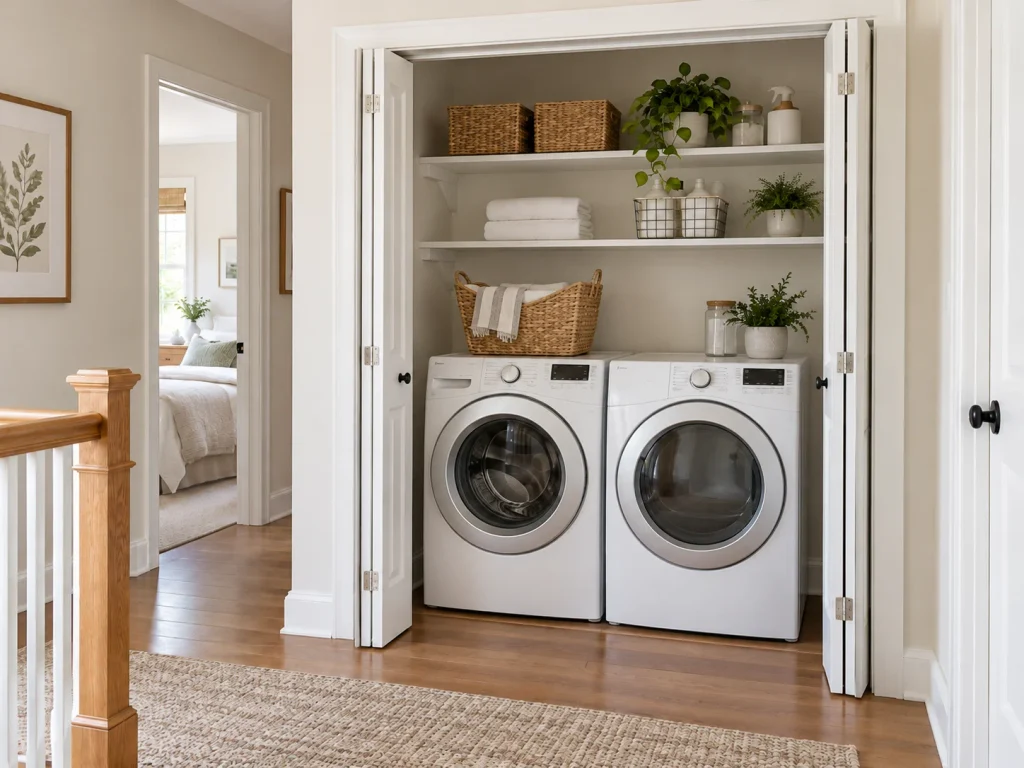
- Bifold Doors: Fold along a track, requiring less clearance than a full swing door. While the panels swing outward during the folding motion, they leave most of the closet opening clear for laundry baskets and washer doors once fully opened.
2. Best Bifold Door Styles and Materials for Laundry Closets
Start with ventilation. If your dryer needs airflow through the closet door, a louvered design may be the better choice. Solid or molded panels are also options, but only when the closet’s ventilation setup meets your appliance manufacturer’s requirements.
- Full-Louvered Doors: Angled horizontal slats run the entire height of the panel. They allow continuous passive airflow to reduce heat and moisture buildup inside closed closets.
- Shaker / 2-Panel Molded Doors: Recessed or raised panels match standard interior doors. They restrict direct airflow, though minor perimeter gaps around the frame still remain.
- Solid Panel / Flush Doors: Smooth, minimal panels with almost no airflow passage.
- Glass Inserts: Wood or MDF frames with frosted glass panes. They hide messy laundry hampers while letting hallway light pass through.
Door Style Comparison
Which door style fits your laundry closet?
Compare airflow and appearance first. A door’s style alone cannot tell you whether it meets your dryer’s ventilation requirements.
| Door style | Panel airflow | Why choose it | Before buying |
|---|---|---|---|
| Full-louveredSlats across the panels | Open slats | Allows passive air transfer with the door closed. | Check the louvers’ actual unobstructed free area against the dryer manual. Louvers do not replace the exhaust duct. |
| Half-louveredSlats plus a solid section | Varies by design | Adds airflow while keeping part of the door visually solid. | Fewer slats may mean too little free area for some dryer installations. |
| Shaker / flushSolid molded panels | Very limited | Matches nearby interior doors and hides laundry equipment. | Use only if the closet’s separate air-transfer arrangement meets the appliance requirements. |
| Frosted glassGlazed panel inserts | Very limited | Offers a light, polished look with some visual screening. | Confirm air supply, door weight, and compatible hardware; glass alone does not ventilate the closet. |
3. Laundry Closet Ventilation: What You Need to Know
Running a dryer inside a tight, sealed closet traps heat and humidity. Restricted air exchange extends drying times and stresses machine blowers.
Vented Dryers (Electric & Gas)
Vented dryers pull air from the room, heat it, and push moist air out through an exterior wall duct.
- Make-Up Air: If a vented dryer operates in a confined closet without sufficient intake air, restricted airflow starves the blower fan, extends drying cycles, and overheats internal components.
- Gas Dryer Safety: Restricted airflow on gas dryers can disrupt proper combustion venting. Always follow local building codes and National Fuel Gas Code (NFPA 54) guidelines.
- Manufacturer Air Openings: Check your dryer manual for closet installation specifications. For example, the Whirlpool Dryer Installation Instructions specify minimum unobstructed air openings near the top and bottom of the closet door for certain installations. Because ventilation requirements vary by model, check the required free area before selecting a louvered door.
Ventless Dryers (Heat-Pump & Condenser)
Ventless heat-pump and condenser dryers do not need an exterior vent pipe, but they still rely on adequate room air circulation for effective heat exchange.
- Room Air Requirements: Ventless dryers have model-specific temperature and airflow needs. According to GE Appliances’ ventless condenser dryer guidance, the covered condenser dryers should operate with the closet door open. If the door must remain closed, GE specifies louvers providing at least 60 square inches of open area. Check your own model’s manual before choosing a solid-panel door.
4. Standard Bifold Door Sizes and How to Measure
A door labeled 30 × 80 inches may not measure exactly 30 × 80 inches. Check the manufacturer’s required finished opening before ordering.
Terminology That Matters
- Finished Opening (FO): The framed, drywalled, and trimmed opening where the track mounts. Measure this exact opening, not old door panels.
- Nominal Size: The catalog name (e.g., 30″ x 80″).
- Actual Panel Size: Bifold door panels are manufactured smaller than their nominal opening dimensions to allow room for tracks, pivots, and hardware clearances. The JELD-WEN Bifold Door Installation Guide explains how finished-opening measurements relate to door panel dimensions. Check the specifications on your chosen door kit before ordering.
Common Nominal Door Sizes
Common nominal bifold door sizes
Widths and heights below are product labels—not measured panel dimensions or universal finished-opening requirements.
| Nominal size | Typical layout | Potential use | Check before ordering |
|---|---|---|---|
| 24″ × 80″ | 2 panels | Narrow utility storage or exceptionally compact openings. | Often too narrow for full-size laundry appliance access. |
| 30″ × 80″ | 2 panels | Some stacked laundry closets with one machine-width opening. | Verify washer width, loading door swing, and service access. |
| 36″ × 80″ | 2 panels | Wider stacked laundry or utility closet. | Confirm folded-stack width and the appliance’s door swing. |
| 48″ × 80″ | 4 panels* | Narrow double-fold closet or custom equipment arrangement. | Usually too narrow for side-by-side full-size 27″ machines. |
| 60″ × 80″ | 4 panels* | Potential side-by-side laundry access. | Measure usable clear width after both sides fold. |
| 72″ × 80″ | 4 panels* | Wider side-by-side laundry closet with more working room. | Verify the track, finished opening, and equipment clearances. |
Standard door height in North American homes is 80 inches, though 84-inch and 96-inch options exist for high-ceiling builds.
How to Measure Your Opening

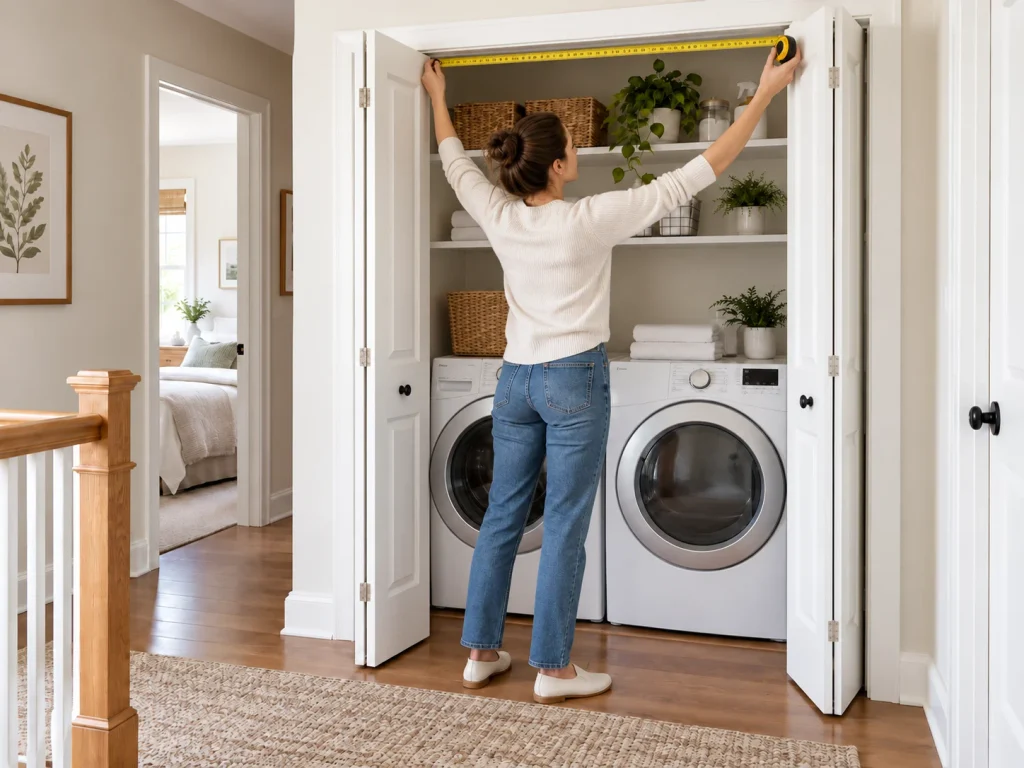
- Measure Width in 3 Places: Run your tape measure horizontally across the finished frame at the top, middle, and bottom. Write down the smallest number.
- Measure Height in 3 Places: Measure vertically from the floor to the bottom of the top trim casing on the left, center, and right. Use the smallest number.
- Check Squareness: Measure diagonally from top-left to bottom-right, then top-right to bottom-left. If the two numbers differ noticeably, check your hardware instructions for shimming and pivot pin tolerances.
5. Washer and Dryer Clearance: Will the Doors Fit?
Before ordering, check the space behind the dryer, in front of the appliances, and along the door’s folding path.
Check depth, clear width, and folding path
A door can fit the wall opening and still interfere with the washer, dryer, or hallway.
Look down into the closet, from rear wall toward the hall.
Model-specific
BODY DEPTH
The folded door stacks take up part of the doorway.
LEFT
RIGHT
- Closet Depth: Calculate the space needed for the appliance body, rear exhaust connections, and front door clearance. GE Appliances explains in its Dryer Minimum Clearance Requirements that installation spacing can vary by model. Check your dryer’s installation manual before deciding whether the closet is deep enough.
- Usable Width: Folded panels rest inside the side frame openings, taking up horizontal space. On a nominal 60″ opening, the clear entry width shrinks when doors fold back. If you ever need to replace a machine, you may need to pop the doors off their pivot pins first.
- Folded Swing Arc: As bifold panels open, their center hinges pivot outward into the hallway before folding flat. Make sure light switches, door casings, or adjacent walls do not block this path.
6. Popular Bifold Door Brands, Prices and Where to Buy
Masonite, JELD-WEN, and RELIABILT are common bifold door brands sold through major U.S. home improvement retailers.
Cost Expectations
Prices vary by core material, wood species, and louver design. Basic hollow-core molded doors start around $70 to $110, while solid-core MDF, wood, or full-louvered sets run from $150 to $300+. (These are illustrative price ranges, not live quotes. Check local home center pricing before budgeting).
Core Types: Hollow vs. Solid
- Hollow Core: Light, affordable, and easy on track hardware, but feels lightweight.
- Solid Core (Solid MDF / Wood Fiber): Heavier and more substantial to the touch, but requires robust track hardware to prevent long-term sag.
7. Acoustic Control: Understanding Noise Reduction Realities
A solid-core door may reduce some noise, but the gaps around bifold panels still let sound through.
- Perimeter Air Gaps: Bifold doors need operating clearances around the top track, floor pivot, and center hinges. Airborne noise passes through these gaps, while vibration can travel through the surrounding structure.
- Louver Slats: Louvered doors let air out—and noise with it.
- Better Sound Control: Level your washer legs, put rubber anti-vibration pads under machine feet, and insulate the laundry closet studs before expecting a door to quiet the room.
8. How to Install Bifold Doors for a Laundry Closet
Put on safety glasses and follow the hardware manual that came with your door set.

- Mount the Top Track: Measure the header opening. Trim the aluminum track with a hacksaw if needed, then screw it into solid framing above.
- Set the Floor Bracket: Align the bottom floor bracket directly beneath the top track pivot socket using a plumb line or level. Screw it into the floor framing.
- Prep the Door Panels: Tap top pivot pins, guide wheels, and bottom adjustable pins into the pre-drilled panel holes as directed.
- Hang the Panels: Fold the door set into a “V” shape. Insert the top pivot pin and guide wheel into the track, then drop the bottom pin into the floor bracket.
- Adjust Fit: Lift panel weight off the bottom pivot before turning the threaded adjustment pin to adjust door height. Slide top track brackets left or right to level vertical gaps along the side trim.
9. Common Laundry Closet Bifold Door Problems and Fixes
- Door Scrapes the Floor: The bottom pin slipped in its bracket. Relieve door weight and adjust the threaded pivot pin according to your hardware instructions to lift the panel off the floor or carpet.
- Top Guide Pops Out of the Track: The door sits too low or the spring-loaded top pin is stuck. Adjust vertical height upward so the top pin stays compressed inside the track channel. Clean lint out of the track.
- Doors Won’t Close Flush: Loosen top track bracket screws, adjust the pivot point laterally until doors sit square, then retighten.
10. FAQs and Final Buying Checklist
Frequently Asked Questions
Q1: Can I trim a bifold door to fit an uneven opening?
A: Check your door warranty first. Some molded bifold doors allow minor side trims, while others void warranties if cut. Always read brand-specific instructions before applying a saw.
Q2: Where should door handles be installed?
A: Manufacturers like JELD-WEN recommend mounting pull knobs on the lead (guide) panel near the middle rail center. Place them where they offer comfortable leverage without pinching fingers in the fold.
Q3: How do you clean lint out of louvered doors?
A: Use a vacuum brush attachment or microfiber cloth along the slats once a month to prevent dryer lint accumulation.
Q4: Can I buy a single replacement panel for a broken door?
A: Home centers sell bifold doors as hinged 2-panel sets. Matching individual panel thickness and hinge mortises is difficult, so replacing the 2-panel set is usually faster and cleaner.
Laundry closet bifold door checklist
Mark each check once you’ve confirmed it with your own measurements and the relevant appliance and door manuals.
Start with the opening measurements and dryer ventilation requirements.



1 thought on “Bifold Doors for Laundry Closets: Sizes, Ventilation & Installation Guide”
Comments are closed.