
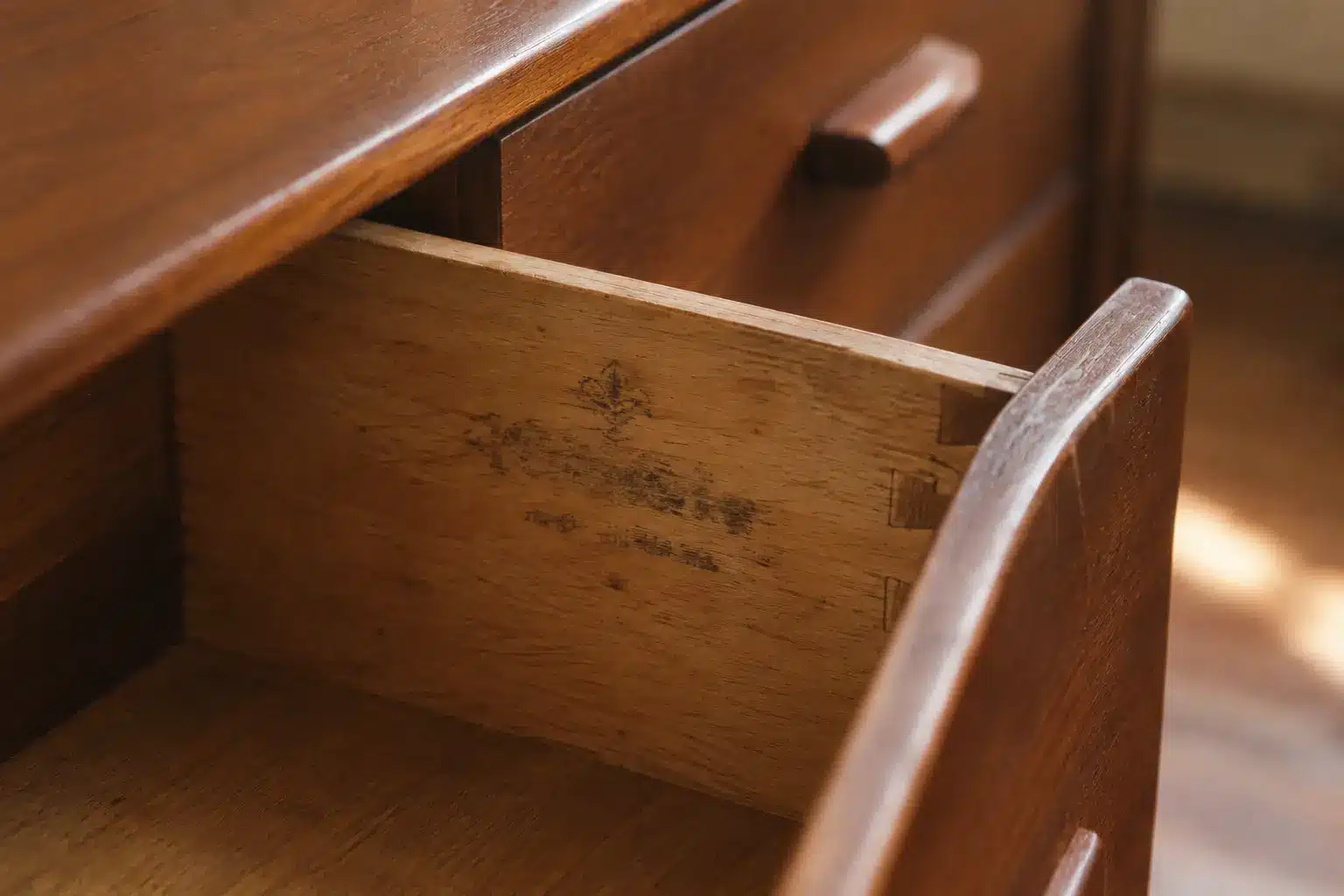
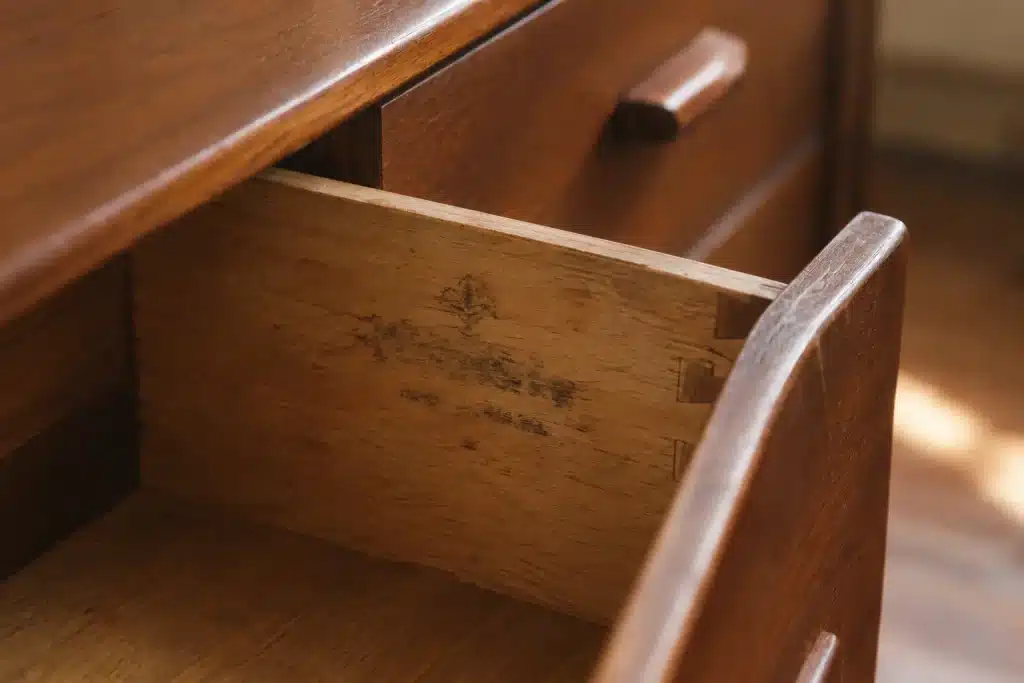
A verified maker’s mark can significantly affect the identification and market value of vintage Mid Century Modern (MCM) furniture. However, a mark alone is evidence, not absolute proof. Because labels can be forged, moved, or degraded over time, accurate evaluation requires examining the mark alongside construction methods, wood species, hardware, model catalogs, and overall condition.
Maker’s Mark Is Evidence, Not Proof
A maker’s mark provides valuable clues about a piece’s origin, but it rarely establishes full provenance on its own.
- Mark Present ≠ Automatically Authentic: Labels can be transferred from low value pieces to unbranded furniture, and hot iron stamps can be reproduced.
- No Mark ≠ Fake: Many authentic mid century pieces never received a mark, or they relied on paper labels and hangtags that deteriorated over decades of use.
- Holistic Evaluation: A reliable identification relies on matching multiple details: drawer joinery, hardware type, leg attachment methods, wood veneer selection, and documented manufacturer catalogs.
The 5 Primary Types of Vintage Marks
Hot Iron Brands
Heat branded impressions pressed into solid timber. Commonly found on solid wood lines like Heywood Wakefield or Scandinavian artisan creations, these marks leave a dark, indented impression in the grain.
Stamped Ink
Inked stamps applied directly to raw wood. Widely used on American case goods along drawer sides, interior walls, or rear backboards.
Metal Badges & Medallions
Stamped brass or aluminum plates screwed or riveted into interior drawer walls. Higher end collections frequently used these for branding.
Paper & Foil Labels
Adhesive backed metallic foil or paper tags applied to finished surfaces, drawer bottoms, or backboards. These are sensitive to humidity and friction, making intact original labels relatively rare.
Woven Fabric Tags
Cloth labels sewn into underside dust covers, jute webbing, or cushion seams on upholstered lounge chairs and sofas.
Examples of Common MCM Identification & Mark Systems
| Maker / System | Typical Location | Mark Type | What It Provides (And Limitations) |
| Lane Furniture | Top drawer exterior side or table underside | Inked Stamp | Production Date Tracking: Lane’s serial numbers are read backward to reveal the manufacturing date. For example, Lane documents that serial number 753150 reads backward as 051357 (May 13, 1957). |
| Broyhill | Upper right interior drawer wall (near dovetails) | Metal Badge or Inked Stamp | Identifies signature lines (such as Brasilia or Sculptra). Should be verified against documented catalog hardware and wood grain patterns. |
| Heywood Wakefield | Interior top left drawer wall, table underside, or headboard stretcher | Hot Iron Brand or Paper Label | Indicates production era (e.g., the stylized eagle logo was introduced in 1949). Should be cross referenced with solid birch/maple construction and proprietary finish colors. |
| Danish Furnituremakers’ Control | Table apron underside or main leg joinery | Circular Metal Badge or Stamp | Quality Association Seal: Indicates participation in the voluntary quality control scheme founded in 1959 by the Association of Danish Furniture Manufacturers (Dansk Møbelkontrol). It is an industry quality seal, not standalone proof of a specific designer or production year. |
Where to Look: Placement Locations by Furniture Type
Manufacturers generally placed marks in discreet, protected areas to avoid disrupting the clean exterior aesthetic of mid-century design.
Dressers, Credenzas & Case Goods
- Top Drawer Interior: The interior side wall (often the right or left side near the front dovetail joint) of the top drawer.
- Drawer Box Underside: The raw underside of the drawer box or the exterior back wall of the drawer casing.
- Rear Backboard: The exterior back panel of the cabinet, usually stamped near an upper corner.
Dining & Coffee Tables
- Under the Apron: The interior side of the wooden apron frame directly supporting the tabletop.
- Leaf Cavity: Inside the internal slide mechanism or storage recess housing extension leaves.
- Mounting Brackets: The underside of wooden support rails or metal leg attachment plates.
Chairs, Loungers & Upholstery
- Underside Seat Frame: The bottom perimeter of the inner wooden frame.
- Behind Webbing: Attached to or tucked behind jute/rubber support straps under the seat deck.
- Cushion Enclosures: Inside zipper seams or sewn onto bottom dust covers.
Non Destructive Inspection & Authentication Techniques
- Adhesive residue
- Inconsistent ink
- Finish repairs
Raking Light (45-Degree Angle)
Hold a high lumen flashlight parallel to the wood surface. The low angle light casts shadows inside micro grooves, making faded hot iron burns or faint stamped impressions visible under thin layers of old finish.
UV / Blacklight Inspection
Ultraviolet light can highlight differences in inks, surface finishes, adhesive residues, or later structural repairs. While useful for spotting alterations, UV inspection is a supplementary tool rather than a standalone test.
Wear Pattern Consistency
Evaluate the condition of the mark against the surrounding wood. A fresh, crisp stamp on an otherwise heavily aged, stained, or worn surface suggests a recent addition or label transfer.
Restoration Tip: Before beginning any refinishing or cleaning process, document all stamps, labels, and construction details with clear photography. Solvent exposure or sanding can permanently eradicate faint markings.
Spotting Reproductions, Alterations, and Anachronisms
Date Anachronisms & ZIP Codes
A 5-digit ZIP Code on an original manufacturer label indicates that the label itself was produced in or after 1963 (when the U.S. Postal Service introduced the system). It provides a useful dating clue, though the label should always be evaluated alongside wood wear and construction details.
Inconsistent Wear and Label Transfers
Examine the perimeter of paper and foil labels under magnification. Disturbed finish lines, dried glue residue extending past the label boundary, or clean wood beneath a degraded label can indicate a transferred mark.
Laser Engravings vs. Vintage Heat Stamps
Modern laser engraving can produce unusually sharp, precise edges and burn patterns that differ from traditional heat branding. Rather than judging by surface appearance alone, compare the mark against documented manufacturer examples and historical catalog specs.
Frequently Asked Questions
Does a maker’s mark prove a piece is authentic?
No. A maker’s mark is one piece of evidence. Labels can be transferred, reproduced, or altered. Authentication requires confirming that construction details, hardware, wood species, and wear patterns match the manufacturer’s documented standards.
Can a missing maker’s mark mean a piece is fake?
Not necessarily. Many mid century manufacturers used paper labels or hangtags that wore off over time. Unbranded pieces from major manufacturers are common in the secondary market and can often be identified through joinery and frame design.
How do you read a Lane furniture serial number?
Lane serial numbers are typically read backward to determine the production date (e.g., serial number 753150 translates to 05/13/57, or May 13, 1957). For 7-digit serial numbers, the extra digit typically denotes the factory or plant location code where the piece was manufactured.
What does the Danish Furnituremakers’ Control mark mean?
It indicates that the piece was produced under the quality assurance system founded in 1959 by the Association of Danish Furniture Manufacturers (Dansk Møbelkontrol). According to Danish furniture industry sources, the mark indicated compliance with established material and construction standards, but it does not identify a specific designer or exact production year on its own.
How do I clean around a fragile paper label?
Do not use water, household cleaners, or chemical solvents on or near vintage paper labels. Clean around the label using a dry, soft bristled brush or a dry microfiber cloth, avoiding direct contact with the edges of the paper.



1 thought on “MCM Maker’s Mark Placement Guide: How to Find, Decode & Authenticate Vintage Furniture Stamps”
Comments are closed.