
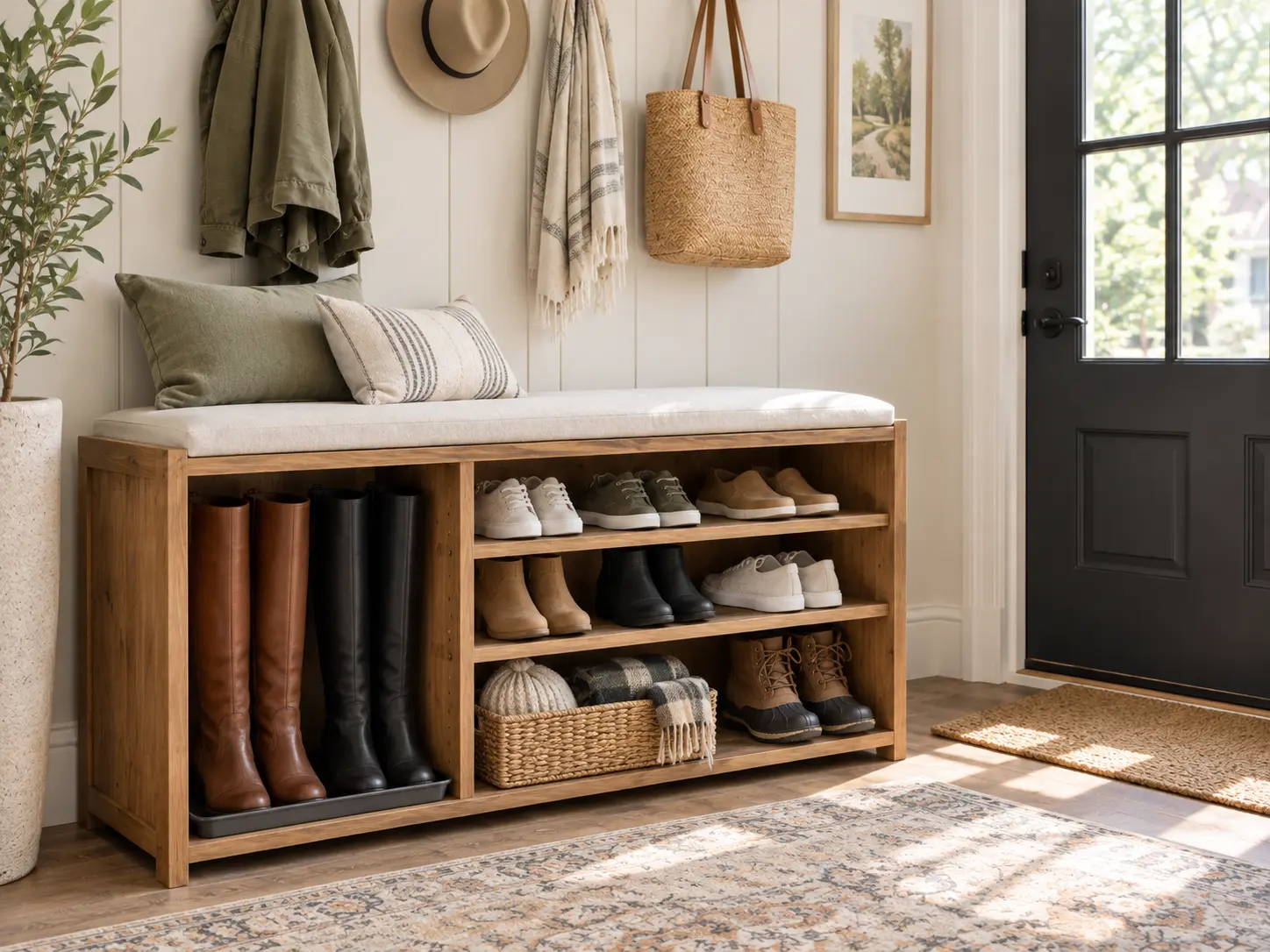
Mudroom benches with shoe storage help keep busy entryways organized by giving everyone a place to sit and store everyday footwear. But finding the right bench takes more than choosing a design that looks good.
The key is selecting a bench that fits your hallway, holds your family’s shoes, and stands up to wet soles. This guide compares storage styles, typical dimensions, weight limits, and practical organization ideas to help you choose the right fit.
Quick Decision Matrix: Which Bench Style Do You Need?
If you need a quick answer to narrow down your options, match your primary entryway issue with the corresponding design style below:
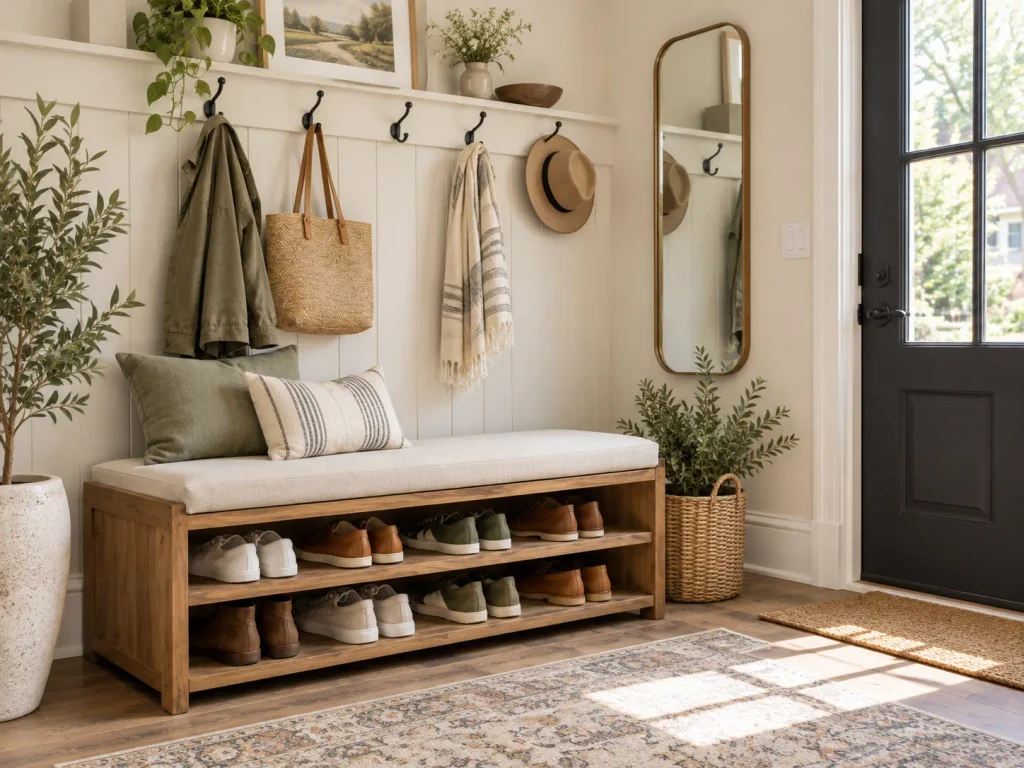
- For Active Households & Kids: Open Shelving Benches. Best for easy access to everyday shoes and allowing wet soles to air dry quickly.
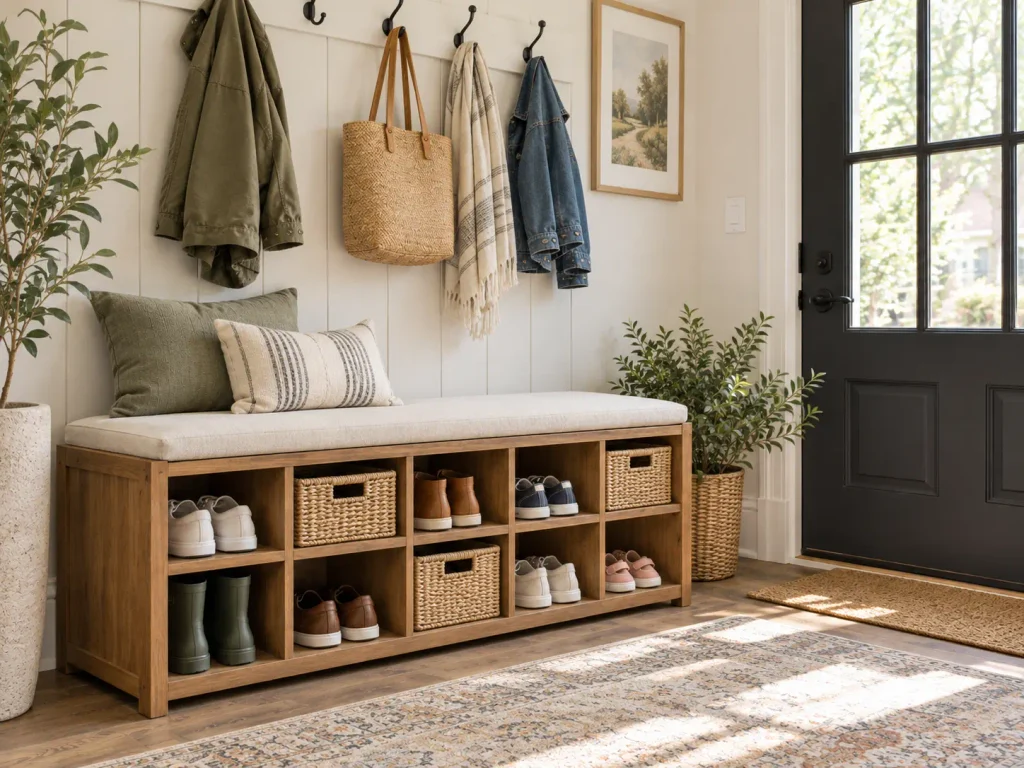
- For Multi-Member Families: Cubby Benches with Bins. Assign individual square compartments or bins to specific family members to keep shoes from mixing together.
- For Shallow Entryways with Some Front Clearance: Flip-Down Storage Benches. Angled internal racks store footwear vertically within a shallow bench depth while still offering a seated top. The doors tip forward when opened, so this style suits a shallow wall zone better than a tight walkway. If walking space is also limited, choose open shelves or cubbies instead, since they need no opening clearance.
- For Formal Entryways & Minimalists: Drawers or Closed Cabinets. Conceals footwear completely to keep the entryway looking tidy and out of sight.
1. Comparing Shoe Storage Bench Styles
Choosing the right design depends heavily on your daily routine, hallway width, and how much shoe clutter you are comfortable seeing.
Important Distinction: Make sure you are looking at a true storage bench, built with a reinforced top frame designed to support human weight, rather than a tall shoe cabinet. Tall cabinets, including tall flip-down shoe cabinets, are meant strictly for vertical storage and cannot be sat on safely.
| Storage Style | Best For | Main Advantage | Drawback / Consideration |
| Open Shelves | Daily shoes, active routines | Maximum airflow; easiest for kids to use | Shoes stay fully visible; requires neat alignment |
| Cubby Systems | Families, organizing per person | Separate storage spots; fits fabric or wicker bins | Fixed compartment sizes limit tall boots |
| Flip-Down Doors | Shallow entryways with some front clearance | Vertical storage in a shallow depth; sleek profile | Doors need front clearance to open; internal angled racks won’t fit heavy, bulky work boots |
| Enclosed Drawers | Formal entryways, minimalist decor | Keeps dust off shoes; clean exterior finish | Requires extra front clearance to open drawers fully |
Open Shelving Benches
Open-tier benches feature slatted wood, wire, or solid metal shelves beneath the main seat.
- Airflow and Drying: Because open shelves do not trap air, damp soles dry much faster than they do inside closed cabinets. This helps reduce mildew risk and odor buildup.
- Low Friction: Without doors or drawers in the way, children and family members can slide shoes in immediately upon walking through the door.
Cubby Benches with Bins
Cubby benches divide the lower frame into uniform grid compartments.
- Assigned Personal Spots: You can assign specific cubbies to individual family members to keep daily shoes separated.
- Flexible Storage: Top cubbies can stay open for daily sneakers, while lower cubbies can hold fabric or wicker baskets for dog leashes, gloves, and small accessories.
Flip-Down Benches and Pull-Out Drawers
If you prefer a clean look with zero visible shoes, enclosed storage keeps everything behind doors or drawers.
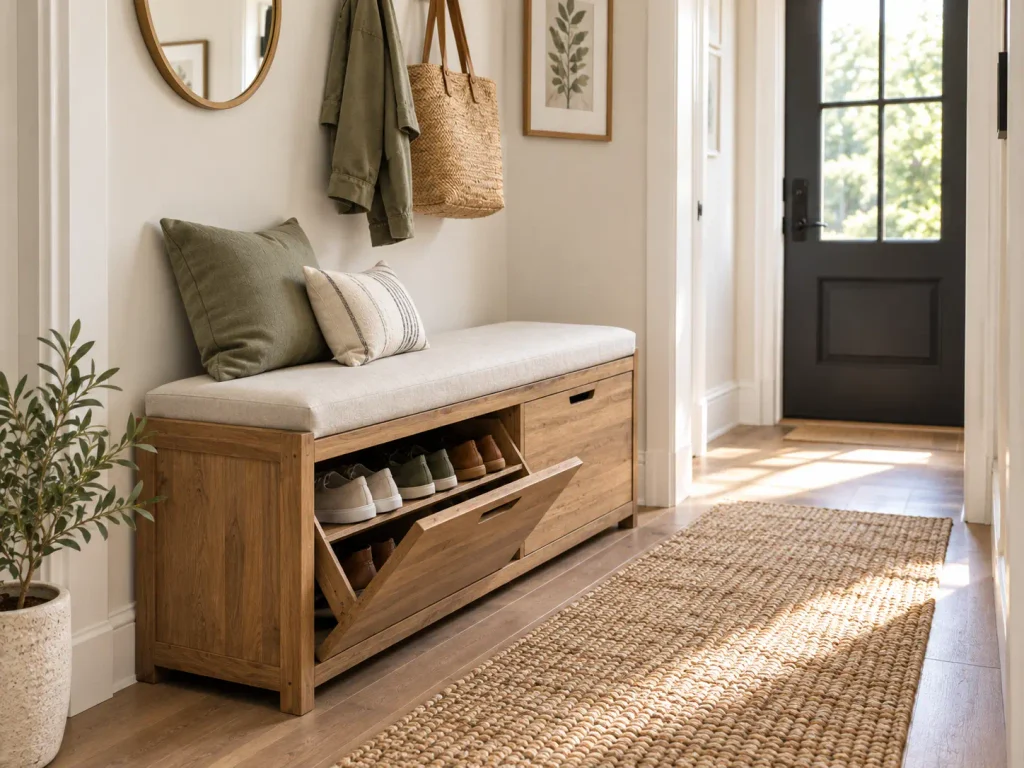
- Flip-Down Storage Benches: These combine a low, reinforced seating surface with front doors that tip forward on angled internal hinges. The angled racks hold shoes upright, so the bench can stay shallow, which is the main reason to choose this style when wall depth is limited. The trade-off is that the doors swing outward when opened, so plan for the front clearance described in the Traffic Flow section below.
- Pull-Out Drawers: Heavy-duty drawers keep shoes completely protected from dust and pet hair, keeping the entryway looking tidy in formal foyers.
2. Typical Dimensions and Measurement Guide
Buying a bench that feels awkwardly sized or blocks traffic is a common oversight. Measure your entryway against these typical dimension guidelines before making a selection.
| Dimension Metric | Typical Range | Why It Matters |
| Seat Height | 18″ – 20″ | Provides comfortable leg clearance for sitting down to lace shoes. |
| Seat Depth | 14″ – 18″ | Ensures sufficient support without encroaching into hallway walkways. |
| Shelf Width per Pair | 8″ – 10″ | Average space required for one adult pair (boots need 10″–11″). |
| Walkway Target | 30″ – 36″ | Recommended planning benchmark for comfortable, unhindered foot traffic. |
Ergonomic Seat Height and Depth
- Seat Height: Most adult seating benches measure 18 to 20 inches from the floor to the top of the seat or cushion. Anything lower than 16 inches feels cramped when untying laces, while heights over 21 inches leave your feet dangling.
- Seat Depth: Typical bench depth ranges from 14 to 18 inches. A depth of 15 to 16 inches provides comfortable seating without taking up unnecessary hallway space.
Calculating Real Shoe Capacity
To figure out how many shoes a bench will hold, budget 8 to 10 inches of shelf width for each adult pair:
- 36-inch Bench: Holds approximately 3 to 4 adult pairs per shelf level.
- 48-inch Bench: Holds approximately 4 to 5 adult pairs per shelf level.
- 60-inch Bench: Holds approximately 6 to 7 adult pairs per shelf level.
Note on Usable Space: Actual shoe capacity depends on usable interior shelf width, side frame thickness, and vertical dividers, not just the bench’s overall exterior width. Always check interior shelf dimensions before purchasing.
Traffic Flow and Door Clearances
This is the one place in the guide where all clearance rules are collected, so use it as your checklist.
- Walking Path: Measure from the front edge of the bench, with any doors or drawers closed, to the opposite wall. The walkway target in the table above should still be clear so people can pass without stepping sideways.
- Door Swing Arc: Check that your front door or coat closet doors clear the bench’s edges by at least 3 to 4 inches when opened fully.
- Extension Space: Flip-down doors and pull-out drawers need additional room in front while open, typically 10 to 14 inches according to manufacturer specifications. Add this to your walkway measurement, because the walkway should stay usable even when someone has a door or drawer open.
3. Materials, Weight Limits & Structural Integrity
A mudroom bench needs to support human weight while taking a beating from dirt, water, and road salt. Static weight limits depend more on joinery, frame bracing, and hardware quality than on raw material category, so always rely on the manufacturer-specified seat rating, and confirm that it comfortably exceeds the combined weight of the people who will use the bench. If a product page lists no seat rating, treat that as a warning sign.
Why Materials Alone Don’t Guarantee Weight Limits
- Solid Wood Construction: While solid hardwood offers high structural density, actual load capacities vary significantly based on leg thickness and joint construction. Never assume a solid wood bench is indestructible.
- Engineered Wood (MDF / Particle Board): Budget-friendly and smooth, but weight limits depend heavily on center support legs and board thickness. Overloading thin MDF shelves with multiple heavy work boots or sitting down abruptly can cause structural sagging over time.
- Metal Frameworks: Welded steel or iron frames offer high strength with a slim profile. Pay attention to shelf attachment points to ensure lower tiers won’t bend under load.
Real-World Product Spec Comparison
To see how materials, frame designs, and manufacturing specs compare in commercial products, examine these three representative bench specifications:
| Feature / Metric | Alaterre Calais 48″ Bench | John Louis Home Shoe Bench | Winsome Dayton Bench |
| Primary Material | Solid Acacia Wood | Solid Pine Wood | Solid / Composite Wood |
| Seat Weight Limit | 250 lbs (50 lbs shelf limit) | 300 lbs (Manufacturer rated) | 200 lbs (25 lbs per shelf) |
| Storage Layout | Woven Bottom Shelf | 10 Shoe Cubbies w/ Removable Dividers | 3 Open Storage Shelves |
| Best Used For | Everyday seating & open shoe storage | Family shoe organization | Everyday shoes & open shelf storage |
Seat ratings in this group span 200 to 300 lbs. Where shelf limits are listed, they are far lower than the seat rating (25 to 50 lbs), so heavy boots belong on the lower shelves in moderation rather than stacked several pairs deep.
Protecting Against Water and Dirt
Entryways deal with constant moisture from rain, snow, and mud.
- Protective Finishes: Make sure wood or MDF surfaces are sealed with a water-resistant finish (such as polyurethane or melamine coating). Unsealed wood absorbs water, causing warping and staining over time.
- Powder-Coated Metal: Ensure metal legs and shelves are powder-coated rather than painted to prevent rust when wet soles rest on them.
- Rubber Boot Trays: For winter weather, placing a shallow rubber tray under or on open lower shelves protects the bench frame from melting snow and corrosive road salt.
4. Shoes, Boots, and Seasonal Organization Tips
Even a spacious bench can overflow if you try to store your family’s entire shoe collection in one spot.
Rotate Shoes by Season
The simplest way to keep your bench organized is to limit shelf space to active, in-season shoes:
- Keep Only Daily Pairs: Limit each family member to 2 or 3 pairs of currently worn shoes on the bench.
- Move Off-Season Pairs: Put winter snow boots in bedroom closets during summer, and store summer sandals away during winter.
- Seasonal Audits: Clean out outgrown children’s shoes and worn-out pairs at the start of spring and fall.
Shelving Flexibility for Tall Boots
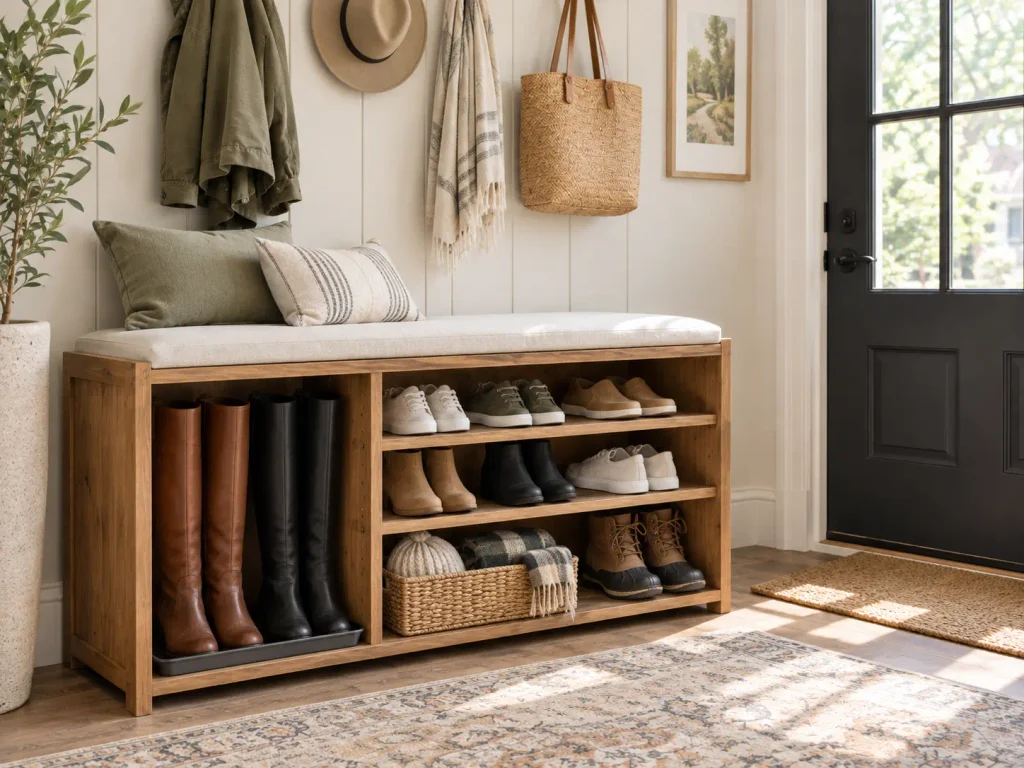
Standard shelf spacing sits at 6 to 7 inches, which works well for sneakers and flats but bends ankle booties and mid-calf boots.
| Shoe Type | Typical Shelf Height | Recommended Storage Method |
| Flats, Sandals & Kids’ Shoes | 4″ – 5″ | Compact tier / Double-stacked adjustable shelf |
| Sneakers & Low Heels | 6″ – 7″ | Standard shelf height |
| Ankle & Mid-Calf Boots | 10″ – 12″ | Lowered adjustable shelf |
| Knee-High Tall Boots | 15″ – 19″+ | Dedicated end compartment OR boot trees stored upright |
Look for models with adjustable pin shelves or removable partitions. For knee-high boots (which require 15 to 19+ inches), avoid forcing them onto standard shelves. Instead, remove a vertical shelf insert entirely or use boot shapers/clips to store them upright in a dedicated tall corner section.
5. Styling Your Bench to Fit Your Entryway
Pairing your bench with soft accents and surrounding wall decor makes the entryway more practical and welcoming.
Cushions and Fabric Choice
Adding a seat cushion makes tying shoes more comfortable while softening the hard lines of the furniture:
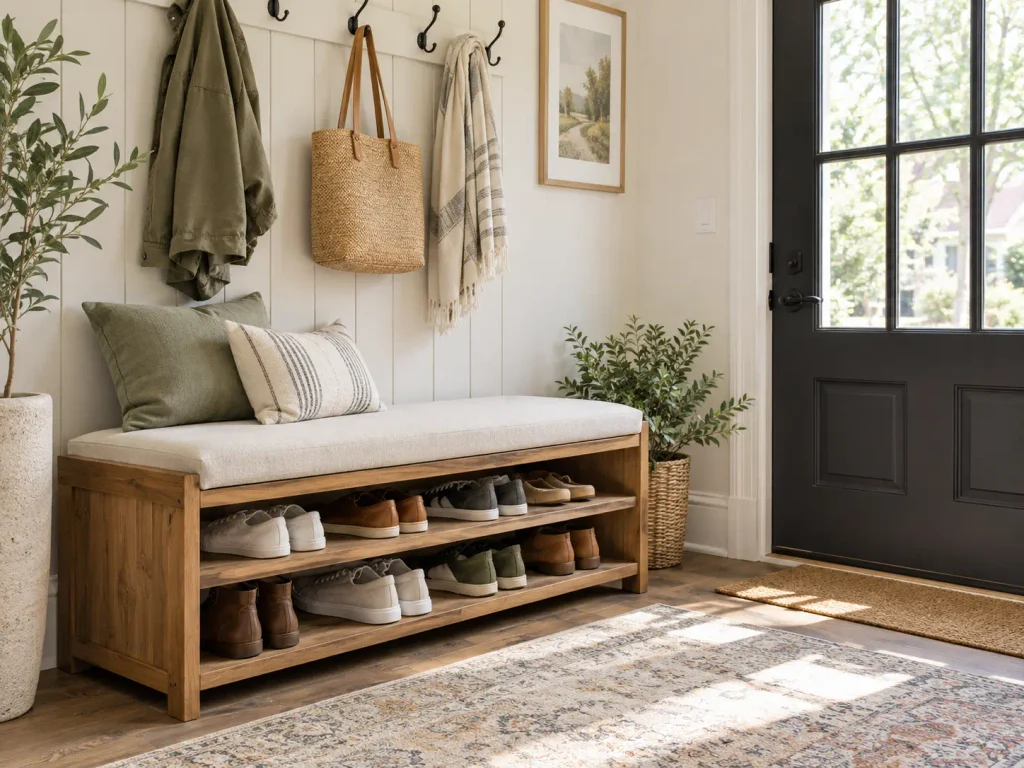
- High-Density Foam: Choose a 2 to 3-inch foam cushion that holds its shape under daily sitting.
- Durable Fabrics: Pick stain-resistant fabrics like solution-dyed acrylics, treated canvas, or removable zippered covers that can go straight into the washing machine.
Vertical Wall Setup
Use the wall space directly above your bench to build a complete entry station:
- Wall Hooks or Peg Rails: Mount a row of coat hooks 24 to 30 inches above the bench seat for jackets, hats, and backpacks.
- Wall Mirrors: Hanging a mirror above the bench reflects light to make tight entryways feel larger, while giving you a spot for a quick check before walking out the door.
6. Common Buying Mistakes & FAQ
What are the most common mistakes when buying a mudroom bench?
- Skipping the Clearance Check: Buying a bench that fits the wall length but blocks a closet door, the front door, or the opening space that flip-down doors and drawers need (see the Traffic Flow section).
- Confusing Cabinets with Benches: Purchasing a tall flip-down shoe cabinet assuming it can be sat on, which creates a safety and breakage hazard.
- Skipping Wall Anchor Kits: Neglecting to anchor tall or lightweight cubby benches to wall studs, which creates a tipping risk when kids sit down or pull heavily on drawers.
How much weight can a standard entryway bench hold?
It varies by construction. The three examples above are rated for 200 to 300 lbs on the seat, with much lower shelf limits. Section 3 explains why the manufacturer’s rating is the number to trust.
How do I clean and maintain a wet shoe storage bench?
Wipe down water, mud, and road salt residues promptly using a soft microfiber cloth dampened with mild soap and warm water. Avoid harsh chemical cleaners that can strip protective polyurethane seals, and use removable rubber drip trays during heavy snow months.


1 thought on “Mudroom Benches with Shoe Storage: Types, Sizes & Buying Tips”
Comments are closed.